Log in
 Help
 Contact
 English
 Français
 Español
 Italiano


Uber Eats, Deliveroo, DOOD… today your restaurant can sell through many channels. But do you really know what sets them apart?
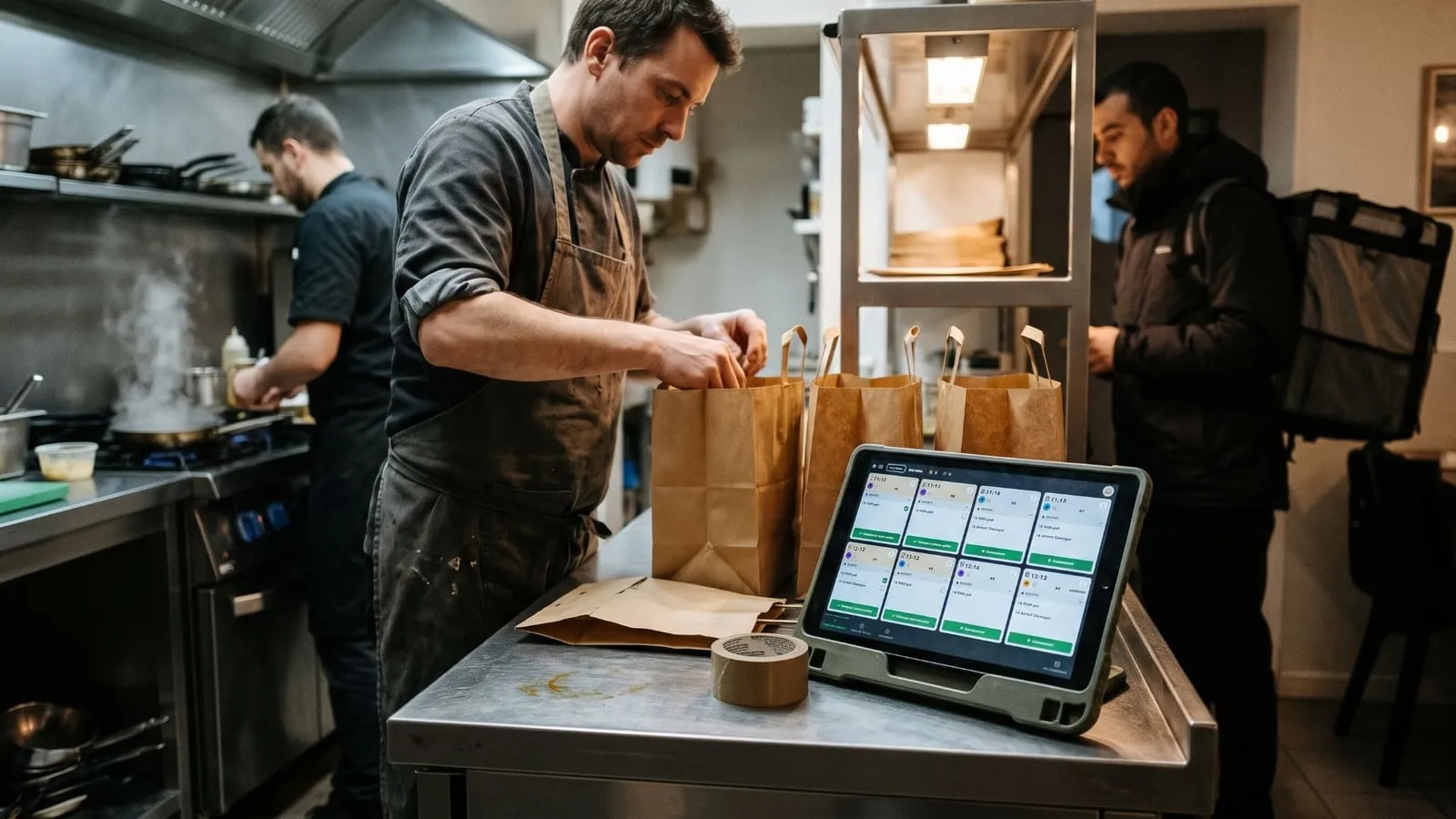
And above all: how can your kitchen handle all these orders without piling up tablets and tools?
The heart of your restaurant business is getting every incoming order out quickly, so customers are happy and never kept waiting.
That’s where a KDS (Kitchen Display System), or kitchen display, becomes essential.
Uber Eats, Deliveroo and DOOD are not quite the same solutions
Uber Eats, Deliveroo and DOOD don’t play quite the same role in your ordering journey.
Uber Eats and Deliveroo: the big delivery platforms
Uber Eats and Deliveroo are platforms where consumers discover your restaurant, place their order and arrange its delivery.
They give the restaurant access to a large audience without having to build its own ordering journey.
It’s a real customer acquisition lever.
But that visibility comes at a cost: the restaurant depends on a third-party platform and has to work with its rules and its commissions.
DOOD: taking back control of your ordering channels
DOOD works differently.
It lets restaurants build their own digital ordering channels: online ordering, click & collect, order at table, kiosks or direct delivery.
The goal is to let the restaurant build a digital experience under its own brand and keep more control over its customer journey and its data.
DOOD also offers white-label delivery with Uber Direct.
In practice, the customer orders directly from the restaurant, through its own channel, but the delivery can be carried out by Uber’s courier network.
The customer stays in the restaurant’s ecosystem, without necessarily going through the Uber Eats marketplace.
So, do you have to choose between Uber Eats, Deliveroo and DOOD?
Not necessarily.
A restaurant can perfectly well have:
Uber Eats + Deliveroo + its own ordering website + Click & Collect + dine-in orders.
Each channel can serve a different goal.
Delivery platforms
They help you reach new customers and increase your visibility.
Your own channel
It lets the restaurant build a direct relationship with its customers and keep better control of its ordering journey.
Click & Collect
It offers a digital experience while avoiding the cost of delivery.
Direct delivery
It lets you sell through your own channel while relying on a logistics partner for the delivery.
So the channels can complement each other.
How do you handle all these orders in the kitchen?
Multiplying the touchpoints with your customers to grow your business and increase your sales is great!
But for your team, it doesn’t matter where the order comes from.
Every one of them has to be prepared.
That’s where a KDS (or kitchen display) becomes indispensable.
If you want to understand exactly how a KDS connected to Uber Eats works, read our article Uber Eats KDS: how does a kitchen display work?
A KDS to centralise all your orders
Without a KDS, each channel can quickly end up with its own way of working.
An Uber Eats tablet. A Deliveroo tablet. A till. Online orders. Paper tickets.
The more the restaurant grows its digital sales, the more devices the kitchen can end up juggling.
With a kitchen display, orders can be brought together in a single production environment.
That’s where the connection between the platforms and the KDS becomes strategic
Simply centralising orders is already useful.
But some integrations go further.
Take Uber Eats as an example.
With a direct connection between Uber Eats and TicknCook, courier information can flow straight to your kitchen display.
The kitchen can see their estimated arrival time and adjust its priorities.
Orders picked up by the same courier can also be grouped together.
Find out more about why you should connect your KDS directly to Uber Eats and how this connection can help your kitchen better sync production and delivery.
What about orders from your own channels?
That’s where integrating with solutions like DOOD really makes sense.
DOOD offers an API solution, DOOD Partners Connect, which connects the platform to more than 100 business tools and centralises operations.
For a restaurant or a chain building its own digital channels, the challenge is to get orders flowing automatically all the way to the production system.
With TicknCook, you get free access to all our partner integrations, so receiving your orders on your kitchen display is never a problem.
The real challenge: building an omnichannel kitchen
Today, restaurants can no longer design their kitchen around dine-in service alone.
Production has to handle, all at the same time:
- dine-in orders;
- phone orders;
- Click & Collect;
- Uber Eats;
- Deliveroo;
- kiosks and other digital channels.
The kitchen becomes omnichannel.
Where does TicknCook fit in?
TicknCook sits precisely at this stage: between your ordering channels and your production.
With TicknCook, there’s no need to choose between Uber Eats, Deliveroo, DOOD or your own channel.
You can handle orders quickly and without errors, wherever they come from.
Your teams get a centralised view of production. They can organise priorities, track orders and split the work across several screens.
To go further, find out how TicknCook’s combined view takes you from simply handling orders to truly running your production.
And when some platforms send extra information, such as Uber Eats courier details, TicknCook can use it to help the kitchen better sync its production.
And if your main goal is to cut errors and improve customer satisfaction by organising orders better, read our article How to manage Uber Eats orders in the kitchen to improve customer satisfaction.
Uber Eats, Deliveroo or DOOD: the best channel is the one that fits your strategy
There isn’t necessarily a single channel that is “the best”.
Platforms can bring you visibility and new customers.
Your own channel can help you build a direct relationship with your customers.
Running your own delivery can give you more control over your customer experience.
The idea is to build a consistent ecosystem.
And above all, to make sure your kitchen can keep up.
Because a restaurant can’t sell more if it can’t produce more
Your digital strategy starts on the customer side.
But it also plays out in the kitchen.
That’s why the kitchen display becomes a central piece of your digital ecosystem.
Do you use several ordering channels?
Uber Eats, Deliveroo, DOOD, Click & Collect, website…
Find out how TicknCook can centralise your production on one or more kitchen displays.